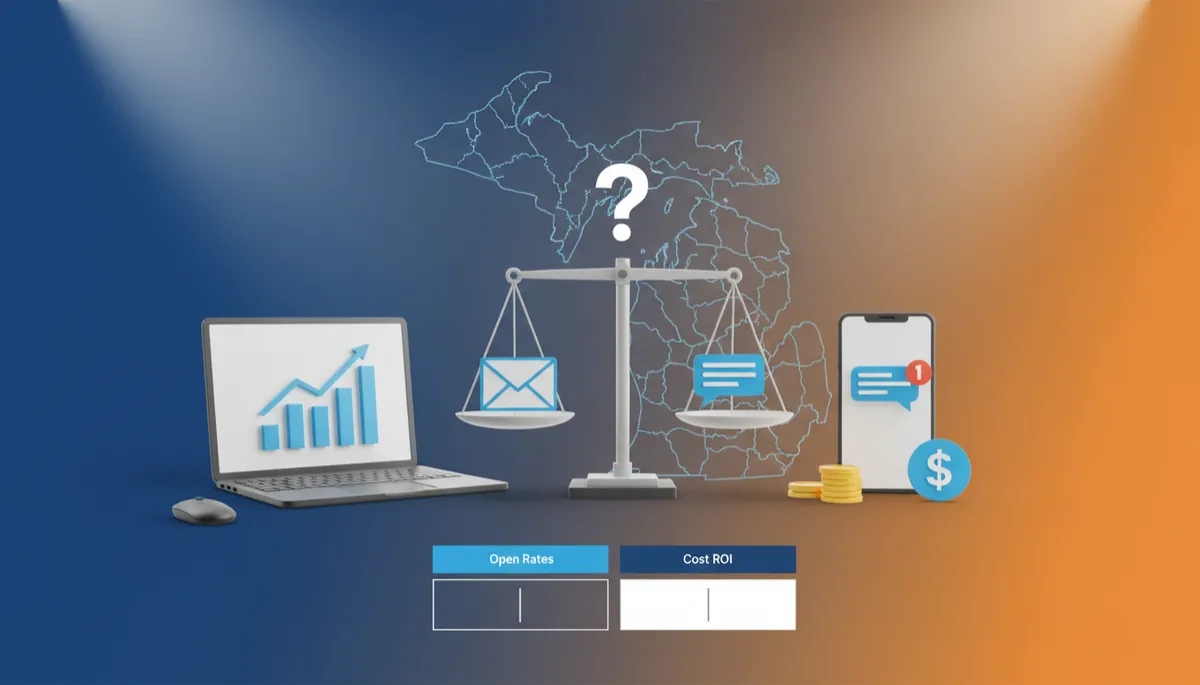
Email vs SMS Marketing: Best Choice for Business
Marketing, Email Marketing vs SMS Marketing
Email Marketing vs. SMS Marketing: Which Is Better for Your Business?
If you run a small business in Michigan, you’ve probably wondered whether email marketing or SMS marketing will give you more bang for your buck. Both channels can drive sales, bookings, and repeat visits—but they work differently, carry different compliance responsibilities, and shine in different situations. This balanced, data-informed guide breaks down email marketing vs SMS marketing so you can make confident decisions for your next campaign.

Email vs SMS at a Glance: Open and Click-Through Rates
Email remains a workhorse for email campaigns small business owners rely on. Across industries in 2026, average email open rates typically fall between 26–31%, with click-through rates (CTR) around 1.7–3.1% depending on list quality and segmentation (Omnisend, Mailsend, GDMA). Automated flows—like abandoned cart or welcome sequences—perform even better, with some platforms reporting CTRs above 5% and conversion rates near 2%.
SMS, by contrast, is almost impossible to ignore. Industry reports show 93–98% of texts are viewed, with about 95% opened within three minutes (DigitalApplied). However, those “open rates” mostly reflect that messages appear on the lock screen, not that people truly engage. A better metric is CTR: median SMS click-through is roughly 8.7%, and many e‑commerce campaigns see 11–20% CTR (DigitalApplied, Omnisend). That’s several times higher than most email programs.
Cost and ROI: Where Do You Get the Best Return?
Most email platforms charge based on list size or monthly send volume. For many Michigan small businesses, that translates to a few cents—or less—per subscriber per month. Multiple studies place email’s average ROI between $20 and $45+ for every $1 invested, with advanced teams using AI tools achieving even higher ratios (Litmus, SearchLab). Email’s low cost per send makes it ideal for nurturing relationships over time with newsletters, promotions, and updates.
SMS messages typically cost more on a per-send basis, especially when using registered 10DLC numbers and compliant platforms. Yet the revenue per send can be impressive. E‑commerce benchmarks show SMS campaigns generating around $0.15 per send, while automated SMS flows reach about $0.71–$0.74 per send (Omnisend, DigitalApplied). That’s why many brands report that text marketing accounts for 21–30% of total marketing-attributed revenue even when it’s a smaller share of total messages (SimpleTexting).
Compliance Requirements: Email vs SMS in 2026
Email marketing in the U.S. is governed primarily by the CAN‑SPAM Act. You must clearly identify promotional messages, include your physical mailing address, avoid deceptive subject lines, and provide a working unsubscribe link that is honored promptly. While violations can be costly, reputable email platforms make compliance straightforward with built‑in footer and unsubscribe tools.
SMS marketing is stricter. Under the Telephone Consumer Protection Act (TCPA), promotional texts generally require prior express written consent specific to your brand. As of 2026, “one‑to‑one consent” rules mean you can’t share opt‑ins across multiple businesses. You must:
- Clearly disclose program name, message frequency, “msg & data rates may apply,” and links to terms and privacy policy (CTIA guidelines).
- Send a non‑marketing confirmation text after opt‑in, and honor STOP requests immediately.
- Properly register your 10DLC or short code campaigns with carriers to avoid blocking.
Penalties for TCPA violations can reach $500–$1,500 per illegal text, so Michigan businesses using SMS marketing Michigan wide should treat compliance as non‑negotiable.
Clear opt-in language and tracking protect revenue while keeping customers’ trust.
Best Use Cases for Michigan Small Businesses
| Metric / Factor | Email Marketing | SMS Marketing |
|---|---|---|
| Typical Open Rate | 26–31% (campaigns) | 93–98% viewed on device |
| Typical CTR | 1.7–3.1% (higher for automations) | 8.7–20% depending on campaign |
| Cost Per Send | Very low; best for frequent messaging | Higher; best for high-value moments |
| Compliance Burden | Moderate (CAN-SPAM) | High (TCPA, CTIA, carrier rules) |
| Best For | Newsletters, education, promotions, storytelling | Flash sales, reminders, confirmations, urgent alerts |
For a Detroit retailer, text message marketing Detroit can be ideal for same‑day flash sales or back‑in‑stock alerts, while email can carry lookbooks, seasonal stories, and loyalty content that builds brand over time.
When to Use Email, SMS, or Both Together
If you must choose just one channel, email is usually the safer starting point. It’s cheaper, more forgiving on compliance, and well‑suited to educating customers about your services, sharing reviews, and promoting events across Michigan communities from Ann Arbor to Traverse City. It’s also powerful for re‑engaging lapsed customers with segmented offers.
However, the strongest results often come from combining both. For example:
- Send an email with full details of a weekend sale, then an SMS reminder on Saturday morning to opted‑in subscribers.
- Use email to nurture new leads with educational content, and SMS to confirm appointments and reduce no‑shows.
- Pair order‑confirmation emails with delivery‑status texts for a smoother customer experience.

Coordinated email and SMS campaigns often lift revenue more than either alone.
FAQ: Email and SMS Marketing for Michigan Small Businesses
Q1: Is SMS marketing legal in Michigan?
Yes—provided you follow federal laws like the TCPA and CTIA guidelines, obtain prior express written consent, and respect state-level telemarketing rules. Working with a compliant platform and experienced partner reduces risk.
Q2: Which channel has better ROI for small businesses?
Studies consistently show strong ROI for both. Email often delivers $20–$45+ per $1 spent, while SMS can drive high revenue per send—especially in automated flows. The “better” channel depends on your margins, offer value, and how quickly a response matters.
Q3: How often should I send emails and texts?
Many Michigan small businesses see good results with 1–4 emails per month and 2–8 texts per month for fully opted‑in subscribers. The key is to monitor unsubscribes and replies—if opt‑outs rise, dial back frequency or increase relevance.
Q4: Can I use the same list for email and SMS?
You can invite email subscribers to opt in to SMS, but you cannot assume consent. For SMS, you must collect explicit, documented permission that meets TCPA and carrier standards. A simple “Join our VIP text list for exclusive offers” form works well when done correctly.
Q5: How do I measure success beyond open rates?
Focus on click-through rates, conversion rates, revenue per send, and customer lifetime value. With Apple Mail Privacy Protection inflating email opens and SMS opens being almost universal, clicks and sales tell a clearer story.
Ready to Choose the Right Mix? Partner with Simply Marketing Group
Whether you’re just getting started with email campaigns small business owners depend on, or you’re ready to scale SMS marketing Michigan customers will actually welcome, you don’t have to guess your way forward. Simply Marketing Group helps local businesses design data‑driven strategies, build compliant opt‑in funnels, and coordinate email and text campaigns that work together—not against each other.
From text message marketing Detroit retailers to regional service providers across the state, our team can help you choose the right channel mix, set realistic benchmarks, and track ROI in plain language. If you’d like a tailored plan for your Michigan business, reach out to Simply Marketing Group today and discover how a smarter email and SMS strategy can drive your next stage of growth.
